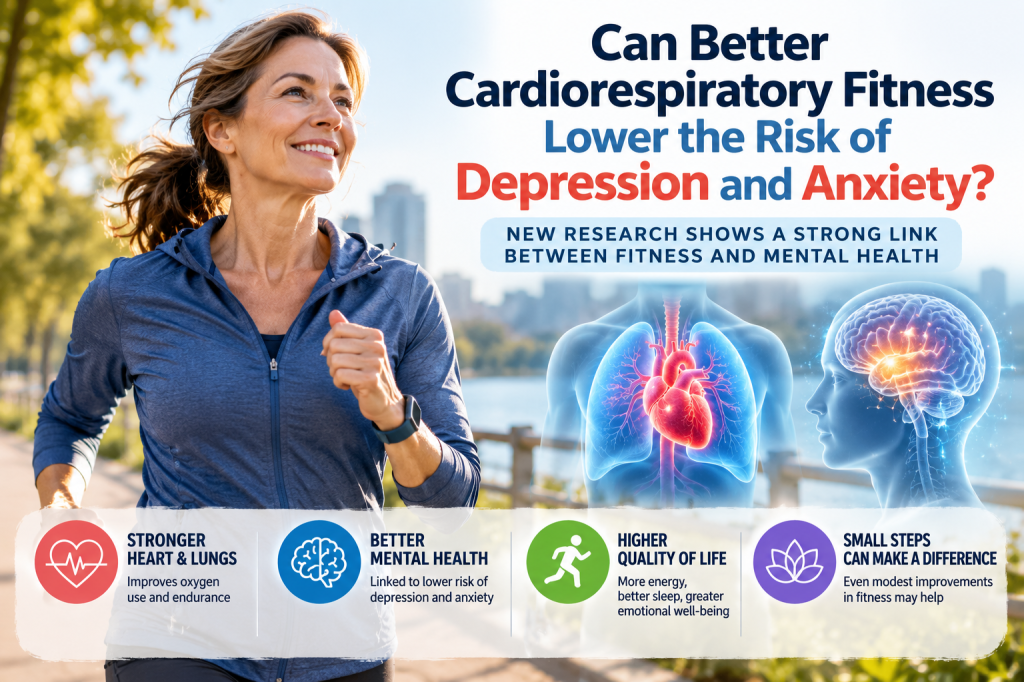
We often think about exercise in terms of weight, blood pressure, or heart health.
But lately, I’ve been learning that fitness may affect more than our bodies.
It may also be connected to our mental health.
A recent large study found that people whose cardiorespiratory fitness improved over time had a lower risk of developing depression and anxiety disorders.
That caught my attention.
Because it suggests that improving the way our heart and lungs work during activity may matter for emotional health too.
What Is Cardiorespiratory Fitness?
Cardiorespiratory fitness describes how well the heart, lungs, and muscles work together to supply and use oxygen during physical activity.
In simple terms, it is related to how efficiently our body handles activities such as:
Walking briskly
Climbing stairs
Cycling
Jogging
Swimming
Hiking
Someone with higher cardiorespiratory fitness can usually perform these activities with less effort.
It is often measured using VO2 max or estimated from exercise testing.
What Did the Research Find?
A 2026 study published in Scientific Reports analyzed more than 7 million Korean adults.
Researchers looked at changes in estimated cardiorespiratory fitness over time and then followed participants for several years.
Compared with people whose fitness stayed relatively stable:
Those whose fitness dropped by more than 5% had a higher risk of developing depression and anxiety disorders.
Those whose fitness improved by at least 5% had a lower risk.
The association remained even after researchers adjusted for many other health and lifestyle factors.
Another recent study involving more than 46,000 UK Biobank participants found a similar pattern.
People in the highest fitness group had a lower risk of developing depression and anxiety compared with those in the lowest fitness group.
These results don’t prove that better fitness directly prevents mental illness.
But the pattern is strong enough to make the connection worth paying attention to.
Why Might Fitness Affect Mental Health?
There probably isn’t one single reason.
Regular physical activity can affect many systems in the body.
It may help:
Improve sleep
Reduce chronic stress
Support brain health
Improve blood flow
Reduce inflammation
Improve metabolic health
Increase confidence and energy
Exercise may also influence brain chemicals involved in mood regulation.
The newer research also found differences in certain blood proteins associated with metabolism and brain protection, suggesting that biological pathways may help explain part of the relationship.
The Important Part: Fitness Can Change
What I found most encouraging is that the study didn’t only compare naturally “fit” people with less fit people.
It looked at changes in fitness over time.
That means the message isn’t:
“You either have good fitness or you don’t.”
It may be:
Improving fitness gradually could matter.
That feels much more realistic.
Especially after 50, I don’t think improving fitness has to mean training for a marathon.
It might simply mean being able to walk farther, climb stairs with less effort, or recover more quickly after activity.
What Kind of Exercise Helps Cardiorespiratory Fitness?
Activities that raise the heart rate and breathing rate are usually the most helpful.
Examples include:
Brisk walking
Cycling
Swimming
Dancing
Hiking
Jogging
Elliptical training
The goal doesn’t need to be extreme intensity.
For many people, simply increasing the pace of a regular walk can make a difference.
What I Like About Walking
Walking is probably the most realistic place to start.
It doesn’t require special equipment.
It can be done almost anywhere.
And it’s easy to adjust the intensity.
A gentle stroll may be relaxing.
A faster walk that makes breathing a little deeper can help challenge the cardiovascular system.
I like the idea of asking myself:
Can I walk a little faster today than I did a few months ago?
That feels much more useful than comparing myself with someone else.
Fitness Is Not a Treatment for Depression or Anxiety
This is important.
Exercise can support mental health, but depression and anxiety disorders are medical conditions.
Someone experiencing persistent sadness, hopelessness, panic, severe anxiety, changes in sleep or appetite, or difficulty functioning should not feel that they simply need to “exercise more.”
Professional support may be necessary.
Exercise can be one helpful part of overall care, but it is not a replacement for appropriate medical or mental health treatment.
A Better Way to Think About Exercise After 50
As I get older, I’m starting to see exercise differently.
It isn’t only about weight.
It isn’t only about looking fit.
And it isn’t only about preventing heart disease.
It may also help support:
My mood
My brain
My sleep
My energy
My confidence
My independence
That makes a daily walk feel a little more meaningful.
Small Improvements Still Count
I don’t think the goal needs to be becoming extremely fit.
The encouraging part of this research is that changes in fitness appear to matter.
So maybe the question isn’t:
“Am I fit?”
Maybe it is:
“Am I a little fitter than I was last year?”
That feels like a much better goal.
Sunny’s One Line
Exercise isn’t only about adding years to life. Sometimes it may also help us feel better while we’re living them.


Leave a Reply