Lately, I’ve been seeing stainless steel cutting boards everywhere.
They look clean, modern, and very hygienic.
At first, I thought:
Maybe this is what I should be using instead of my regular cutting board.
But the more I looked into different cutting board materials, the more I realized that there really isn’t one perfect cutting board for every job.
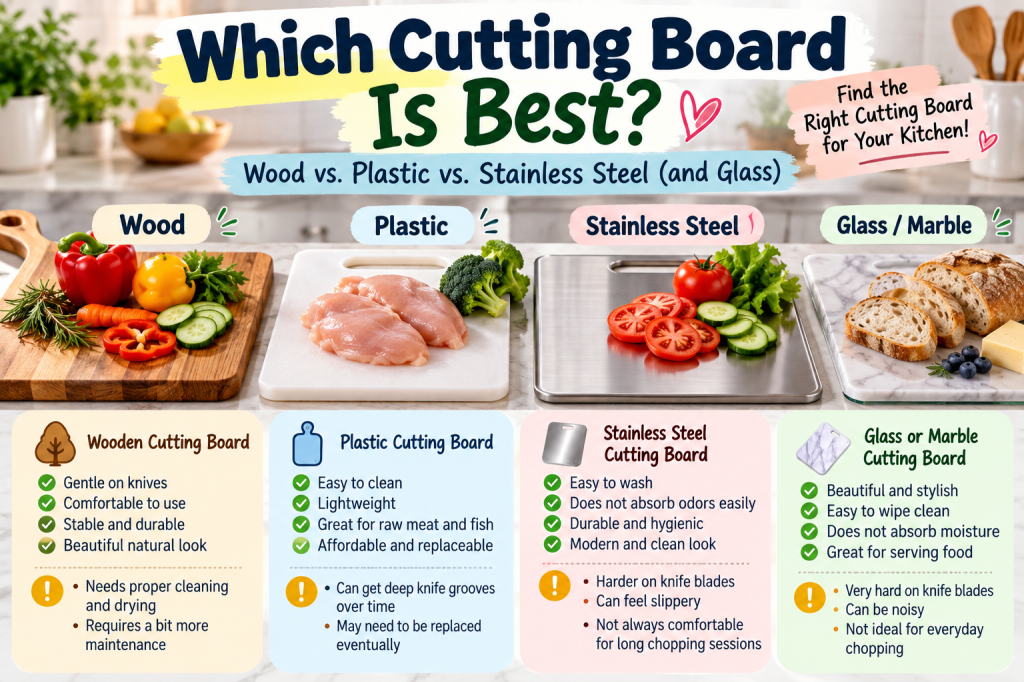
Wood, plastic, stainless steel, and even glass all have different strengths and weaknesses.
So instead of asking, “Which cutting board is the best?” I think a better question is:
Which cutting board is best for the way I actually cook?
1. Wooden Cutting Boards: Gentle on Knives and Comfortable to Use
Wooden cutting boards have been around forever, and there is a reason so many home cooks still like them.
One of their biggest advantages is that they tend to be gentler on knife blades.
When I’m chopping vegetables, herbs, fruit, or bread, a wooden board feels comfortable and stable.
It also has a warmer, more natural look than many other materials.
But wood does require a little more care.
It shouldn’t be left soaking in water, and it needs to be washed and dried properly after use.
Some wooden boards also benefit from occasional conditioning with food-safe mineral oil.
What I like about wood:
- Gentle on knives
- Comfortable for everyday chopping
- Stable on the counter
- Beautiful enough to leave out
What to remember:
Wood needs proper cleaning and drying, and it usually requires a little more maintenance than plastic.
2. Plastic Cutting Boards: Practical for Raw Meat and Fish
Plastic cutting boards are probably the easiest to use for foods that need more careful cleanup.
For raw chicken, meat, or fish, I like the idea of using a separate plastic cutting board.
Many plastic boards are lightweight and easy to wash, and some can go into the dishwasher.
That makes them very practical for foods that may leave behind juices or odors.
The downside is that plastic boards can develop deep knife grooves over time.
Once a board becomes heavily scratched or difficult to clean, it may be time to replace it.
What I like about plastic:
- Easy to clean
- Lightweight
- Useful for raw meat and fish
- Affordable and easy to replace
What to remember:
Watch for deep knife marks and replace the board when it becomes badly worn.
3. Stainless Steel Cutting Boards: Easy to Clean, But Not Perfect
This is the material that made me curious in the first place.
Stainless steel cutting boards look extremely clean and modern.
They don’t absorb moisture or odors the way some other materials can, and they are easy to wipe and wash.
That sounds ideal.
But there is one trade-off that matters to me:
The surface is very hard.
A hard cutting surface can be tougher on knife edges than wood or many plastic boards.
It can also feel a little slippery depending on what you’re cutting.
So after comparing the different options, I don’t think stainless steel needs to replace every cutting board in the kitchen.
For me, it makes more sense as a supplemental cutting board for certain jobs where easy cleaning is especially useful.
What I like about stainless steel:
- Easy to wash
- Does not absorb odors easily
- Durable
- Modern and hygienic-looking
What I don’t love:
- Harder on knife blades
- Can feel slippery
- Not always as comfortable for long chopping sessions
4. Glass or Marble Cutting Boards: Pretty, But Hard on Knives
Glass and marble cutting boards can look beautiful on a kitchen counter.
They’re easy to wipe clean and don’t absorb much moisture.
But as an everyday cutting surface, they aren’t my first choice.
Both materials are extremely hard.
That means they can dull knife blades more quickly and can also be noisy when chopping.
For serving cheese, fruit, or snacks, they can be useful.
For everyday knife work, I would choose something softer.
So Which Cutting Board Is Best?
After comparing the different materials, I’ve realized that I don’t need one cutting board to do everything.
For everyday vegetables, fruit, herbs, and bread:
Wood works very well.
For raw meat, poultry, or fish:
A separate plastic board is practical and easy to clean.
For certain messy jobs or when I want something especially easy to wash:
Stainless steel can be a useful extra board.
That combination makes more sense to me than trying to find one “perfect” cutting board.
A Few Things I Look for Before Buying a Cutting Board
Material matters, but it isn’t the only thing I pay attention to anymore.
I also look at:
Size
A board that is too small becomes frustrating very quickly.
Stability
I don’t want a board sliding around while I’m holding a knife.
Ease of cleaning
If something is difficult to clean, I know I’ll eventually stop using it.
Knife friendliness
A cutting board should work with my knives, not against them.
How I actually cook
The best board for someone who cooks meat every day may be different from the best board for someone who mostly prepares vegetables.
What I’ve Learned
The newest kitchen product isn’t automatically the best one.
And something that looks extremely clean and modern doesn’t necessarily need to replace what has worked well for years.
For me, a good cutting board is one that protects my knives, feels comfortable to use, and is easy enough to keep clean.
Sometimes the best kitchen solution isn’t choosing one winner.
It’s using the right tool for the right job.
Sunny’s One Line
The best cutting board isn’t necessarily the newest material—it’s the one that protects your knives and that you can keep clean with confidence.


Leave a Reply