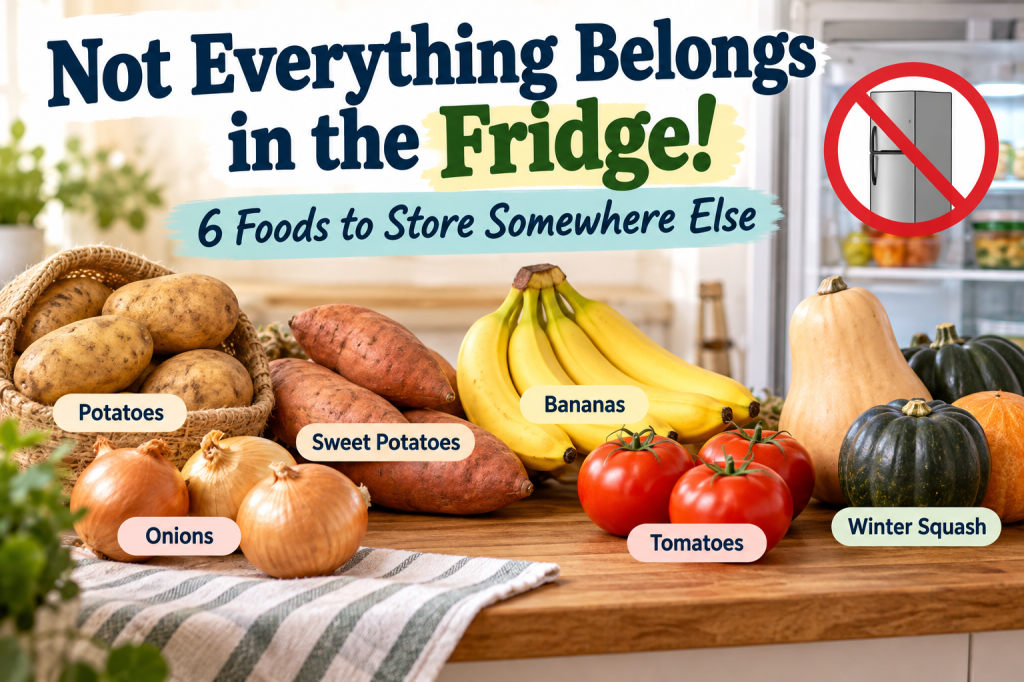
For a long time, I thought the refrigerator was the safest place for almost everything.
Bring groceries home?
Put them in the refrigerator.
Want something to last longer?
Put it in the refrigerator.
Simple.
But I’ve learned that colder isn’t always better.
Some foods actually keep their texture, flavor, or quality better when they’re stored somewhere else.
Here are six foods I’ve started thinking twice about before automatically putting them in the fridge.
1. Potatoes
Potatoes are one food that really prefers a cool, dark, dry place rather than the refrigerator.
Cold temperatures can change the sugars in potatoes, and the FDA specifically recommends storing them outside the refrigerator, preferably somewhere cool and dark.
A pantry, cupboard, or other well-ventilated space can work well.
I also try not to keep them in a tightly sealed plastic bag because a little airflow helps.
One more thing I learned:
Potatoes and onions may both belong outside the fridge, but that doesn’t necessarily mean they should sit right next to each other.
Giving produce some space and airflow can help it keep better.
2. Dry Onions
Whole, dry onions also do well in a cool, dry, well-ventilated place.
I used to put onions in the refrigerator as soon as I brought them home.
Now I usually keep whole onions in a basket or pantry area instead.
Moisture is the enemy here.
A mesh bag, open basket, or container that allows air to circulate works better than a sealed plastic bag.
There is one important difference, though:
Once an onion is cut, I refrigerate the leftover portion in a covered container.
Whole onion and cut onion are two different situations.
3. Sweet Potatoes
Sweet potatoes are another vegetable that doesn’t need to take up precious refrigerator space.
USDA guidance lists sweet potatoes among produce that can be stored in dry storage rather than refrigerated.
A cool, dry place away from direct sunlight is usually a better home for them.
I’ve also noticed that this makes my refrigerator a little less crowded—which is actually helpful because cold air needs room to circulate properly.
4. Bananas
This one probably isn’t surprising.
Bananas ripen best at room temperature.
Putting an unripe banana into the refrigerator can slow the ripening process considerably.
So I usually leave bananas on the counter and let them ripen naturally.
Once they’re ripe, refrigeration can sometimes help slow further ripening, although the peel may darken.
The inside can still be perfectly fine.
And if bananas get too ripe?
That’s when I think banana bread, smoothies, or the freezer.
5. Tomatoes
Tomatoes are a little more complicated.
If they’re not fully ripe, room temperature is generally the better choice because cold temperatures slow the ripening process.
Extension guidance also notes that very cold storage can affect the color, firmness, and flavor of tomatoes.
So when I bring home tomatoes that still need a little time, I leave them on the counter, away from direct sunlight.
Once they are fully ripe, especially if I won’t use them soon, refrigeration may help extend their usable life.
This was a good reminder for me that food storage isn’t always simply “refrigerate” or “don’t refrigerate.”
Sometimes ripeness matters too.
6. Winter Squash
Whole winter squash—such as butternut, acorn, or similar hard-skinned squash—usually prefers a cool, dry location rather than a cold refrigerator.
A pantry or another cool place with good airflow can work well.
Their hard outer skin helps them keep much longer than softer summer squash.
But once I cut one open, the rules change.
Cut squash should go into the refrigerator.
That same rule applies to many fruits and vegetables: whole produce may be fine at room temperature, but once it is peeled or cut, refrigeration becomes much more important.
A Few Things I’ve Learned About Food Storage
One of the biggest lessons for me has been that storage depends on the condition of the food.
Whole versus cut.
Ripe versus unripe.
Dry versus moist.
Those differences matter.
I’ve also learned not to overcrowd the refrigerator.
A packed refrigerator may look efficient, but cold air needs to circulate around food to keep it properly chilled.
So keeping foods that don’t need refrigeration somewhere else actually gives refrigerated foods more room.
What Should Always Go Into the Refrigerator?
This article is about foods that often do better outside the refrigerator, but food safety still comes first.
Meat, poultry, seafood, eggs, dairy products, leftovers, and foods that specifically say “Keep Refrigerated” on the package should be kept cold.
The FDA recommends keeping the refrigerator at 40°F (4°C) or below.
And once fresh produce has been peeled or cut, it generally belongs in the refrigerator as well.
When in doubt, I check the package instructions rather than guessing.
My New Grocery-Unpacking Habit
Now when I unload groceries, I no longer automatically open the refrigerator door first.
I ask:
Does this really need refrigeration?
Potatoes and onions go to a cool, dry place.
Bananas stay on the counter.
Tomatoes get a little time to ripen.
Winter squash goes into the pantry.
It’s a tiny change, but it helps me keep food at its best—and gives me a little more room in my refrigerator too.
Sunny’s One Line
Sometimes keeping food fresher isn’t about making it colder. It’s about finding the right place for it.


Leave a Reply