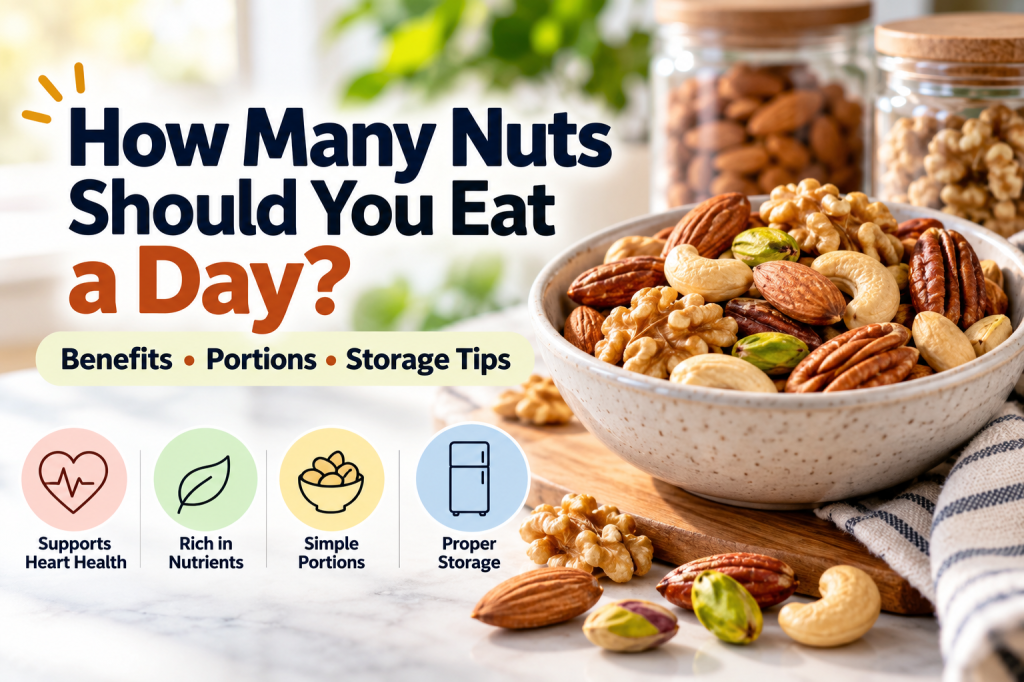
I love nuts because they’re one of the easiest snacks to keep around.
A small handful can be satisfying, easy to carry, and full of nutrients.
But I’ve also wondered:
How much is too much?
Should nuts be stored in the pantry or refrigerator?
And are almonds, walnuts, pistachios, and cashews all basically the same?
The answer is that nuts are nutritious, but portions and storage still matter.
How Much Is a Good Daily Portion?
A simple serving size for most nuts is about:
1 ounce, or about 28 grams
That’s roughly a small handful.
Depending on the type of nut, that may look like:
- About 23 almonds
- About 14 walnut halves
- About 49 pistachios
- About 18 cashews
The exact number varies because nuts come in different sizes.
For me, the easiest rule is simply:
One small handful a day.
Nuts are nutrient-dense, but they are also calorie-dense, so it’s easy to eat much more than one serving without realizing it.
Why Nuts Can Be So Good for Us
Nuts provide a combination of:
Healthy unsaturated fats
Plant protein
Fiber
Vitamin E
Magnesium
Potassium
Antioxidants
Regular nut intake has been associated with better heart health, especially when nuts replace foods higher in saturated fat or refined carbohydrates.
Research has also linked nut consumption with improved cholesterol profiles and lower cardiovascular risk.
That doesn’t mean nuts are magic.
But they can be a very useful part of an overall healthy diet.
Almonds: A Good Source of Vitamin E
Almonds are one of the nuts I reach for most often.
They provide healthy fats, fiber, protein, magnesium, and vitamin E.
Vitamin E acts as an antioxidant and helps protect cells from oxidative damage.
Almonds may also help support healthy cholesterol levels, especially when they replace less healthy snack foods.
Best for:
A filling everyday snack, yogurt topping, or adding crunch to oatmeal.
Walnuts: Known for Plant-Based Omega-3s
Walnuts stand out because they contain alpha-linolenic acid, or ALA, a plant-based omega-3 fatty acid.
That makes them especially interesting for heart health.
Walnuts also contain polyphenols and other antioxidant compounds.
I like them in oatmeal, salads, or mixed with fruit.
Best for:
Heart-friendly fats and adding variety to a mixed-nut routine.
Pistachios: Fiber, Protein, and Potassium
Pistachios are another favorite because they’re satisfying but take a little longer to eat when they’re still in the shell.
They provide protein, fiber, potassium, and healthy fats.
Shelling them one by one also naturally slows me down, which can help with portion control.
Best for:
Mindful snacking and a little extra fiber.
Cashews: Creamy and Rich in Minerals
Cashews are softer and creamier than many other nuts.
They provide magnesium, copper, healthy fats, and plant protein.
Because they have a naturally rich texture, they also work well in sauces and plant-based dishes.
Best for:
Cooking, snacking, and creamy sauces.
Pecans: Rich in Unsaturated Fats
Pecans are rich in monounsaturated and polyunsaturated fats.
They also contain fiber and antioxidant compounds.
I especially like pecans in salads or with fruit, but I try to watch portions because they’re very easy to overeat.
Best for:
Salads, oatmeal, and occasional snacks.
What About Peanuts?
Peanuts are technically legumes, not tree nuts.
But nutritionally, they’re often grouped with nuts because they also provide protein, healthy fats, fiber, and several vitamins and minerals.
Unsalted or lightly salted peanuts can be a very practical option, especially because they are often less expensive than tree nuts.
Raw or Roasted?
Both raw and dry-roasted nuts can fit into a healthy diet.
The biggest thing I look at is what has been added.
Some roasted nuts contain:
A lot of salt
Added sugar
Honey coatings
Chocolate coatings
Extra oils
That doesn’t mean they can never be eaten, but if I’m choosing nuts for everyday snacking, I usually prefer:
Raw or dry-roasted, unsalted or lightly salted
Simple is usually better.
How Should Nuts Be Stored?
This part surprised me.
Because nuts contain a lot of healthy fats, those fats can oxidize over time and create a stale or rancid taste.
That means storage matters.
If I plan to eat them within a few weeks, an airtight container in a cool, dry place can work.
But if I buy a large bag or know I won’t finish them quickly, refrigeration is a better choice.
UC Davis recommends storing nuts in a sealed container in the refrigerator or freezer if they won’t be used within a few weeks.
Cold storage slows oxidation and helps preserve freshness.
Pantry, Refrigerator, or Freezer?
Here’s the simple version:
Pantry:
Good for small amounts you’ll finish fairly soon.
Refrigerator:
Better for longer storage and large bags.
Freezer:
Best if you buy in bulk or want to keep nuts for many months.
Nuts can absorb odors, so I always use a tightly sealed container or bag.
That’s especially important if they’re stored near foods with strong smells.
How Can You Tell If Nuts Have Gone Rancid?
Rancid nuts usually develop an unpleasant smell or taste.
They may smell:
Paint-like
Bitter
Stale
Sharp or oily
If they smell strange or taste bitter in a way they normally don’t, I throw them away.
Healthy fats are one of the biggest benefits of nuts, but those fats are also what make proper storage important.
One Habit That Helps Me With Portion Control
Large bags are convenient, but they make it very easy to eat too much.
So instead of eating directly from the bag, I put a small handful into a bowl.
That simple habit helps me enjoy them without mindlessly eating several servings.
I also like mixing different nuts rather than eating only one type.
Different nuts provide slightly different nutrients, so variety makes sense.
My Simple Nut Routine
I don’t try to make nuts complicated.
My basic rule is:
One small handful.
Mostly unsalted.
A mix of different kinds.
And if I buy a large bag, I keep it in the refrigerator.
That’s enough to make nuts a simple, practical part of my everyday diet.
Sunny’s One Line
Nuts are healthy, but I think the sweet spot is simple: a small handful, a little variety, and good storage.


Leave a Reply