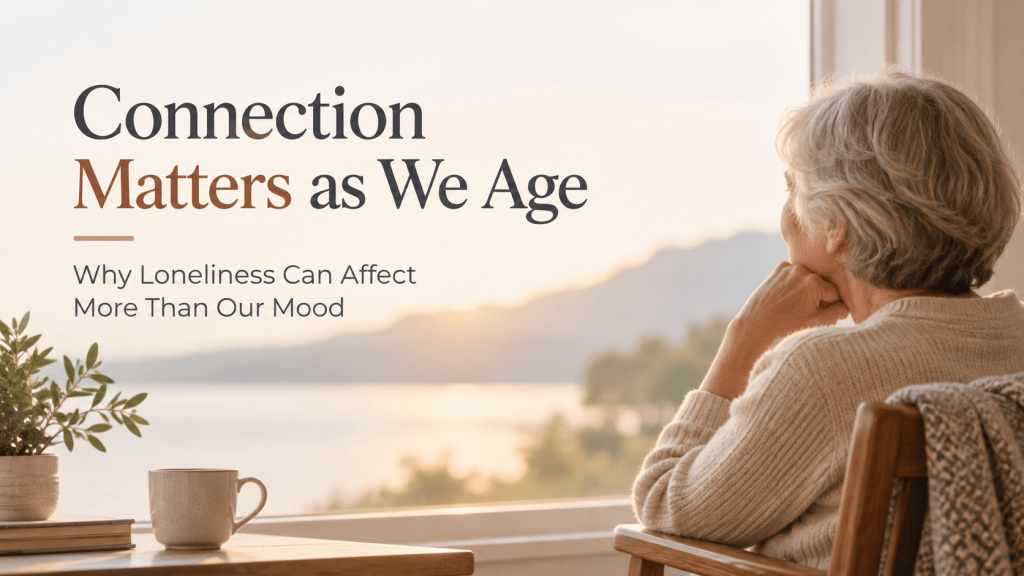
As I get older, I’ve started thinking more about the things that help us stay healthy beyond food, exercise, and vitamins.
One of those things is connection.
Having someone to talk to.
Sharing a meal.
Receiving a phone call.
Meeting a friend for coffee.
Feeling like someone would notice if we weren’t there.
These small moments may seem ordinary, but they can become especially important as we age.
Research shows that loneliness and social isolation can affect not only emotional well-being but physical and cognitive health too.
That surprised me.
Loneliness and Social Isolation Are Not the Same Thing
I used to think being alone and being lonely were basically the same.
They aren’t.
Social isolation means having very few social contacts or relationships.
Loneliness is the feeling that the connection we have is less than what we want or need.
Someone can live alone and feel perfectly content.
And someone else can be surrounded by family, friends, or coworkers and still feel lonely.
That difference matters.
Why Loneliness Can Become More Common With Age
There are many reasons our social world can change as we get older.
Retirement can remove the everyday conversations we once had with coworkers.
Children may move away.
Friends may relocate.
A spouse or close friend may pass away.
Health problems, hearing or vision changes, or difficulty driving can make getting out of the house harder.
None of these things automatically means someone will become lonely.
But they can slowly reduce everyday human connection.
And sometimes we don’t even notice it happening.
Loneliness Can Affect More Than Mood
When we think about loneliness, we often think about sadness.
But long-term loneliness and social isolation have been associated with a number of health problems.
Research has linked them with higher risks for conditions such as heart disease, depression, anxiety, cognitive decline, and dementia.
The National Institute on Aging also notes that chronic loneliness may activate stress responses in the body and can affect inflammation and immune function.
That doesn’t mean loneliness directly causes every health problem.
But it does remind me that emotional health and physical health aren’t separate worlds.
They affect each other.
Our Brains Need Connection Too
One part of this research especially caught my attention.
Social connection may also matter for brain health.
Conversations make us listen, remember, respond, laugh, tell stories, and think.
Even simple social interaction gives the brain something to do.
A large analysis supported by the National Institute on Aging found that loneliness was associated with a higher risk of dementia.
That doesn’t mean someone who feels lonely will develop dementia.
It means social connection may be one of many things worth paying attention to as we think about healthy aging.
Small Connections Still Count
When people hear “be more social,” it can sound like we need a huge group of friends.
I don’t think that’s realistic—or necessary.
Connection can be very small.
Calling one friend.
Having coffee with a neighbor.
Going to church or a community group.
Taking a class.
Volunteering.
Walking with someone.
Video chatting with family.
Even having a regular conversation with the same person each week can give us something to look forward to.
Quality may matter more than having a long contact list.
Technology Can Help—If We Actually Use It to Connect
Phones and social media can sometimes make us feel more connected.
But scrolling through other people’s lives isn’t always the same as having a conversation.
I think technology is most useful when it helps us actually communicate.
A phone call.
A video chat.
A message that turns into a real conversation.
Technology can’t replace every kind of human connection, but it can make distance feel smaller.
Especially when family or friends live far away.
Sometimes We Have to Be the One Who Reaches Out
This may be the hardest part.
When we feel lonely, it’s easy to wait for someone else to call.
But the other person may be sitting at home thinking exactly the same thing.
So I’m trying to remember that reaching out first isn’t a sign that someone cares less about me.
Sometimes everyone is simply busy.
One small message—
“How have you been?”
“Want to have coffee?”
“I was thinking about you.”
—can reopen a connection surprisingly quickly.
Connection Is Part of Healthy Aging
We talk a lot about what to eat after 50.
How much protein we need.
What vitamins we should take.
How much exercise we should get.
All of those things matter.
But maybe we should also ask:
Who did I talk to today?
Who makes me laugh?
Who can I call when I’m having a difficult day?
And who might need me to call them?
Healthy aging isn’t only about keeping the body strong.
It’s also about keeping a place for other people in our lives.
Sunny’s One Line
Sometimes one of the healthiest things we can do for ourselves—and for someone else—is simply reach out and say hello.


Leave a Reply