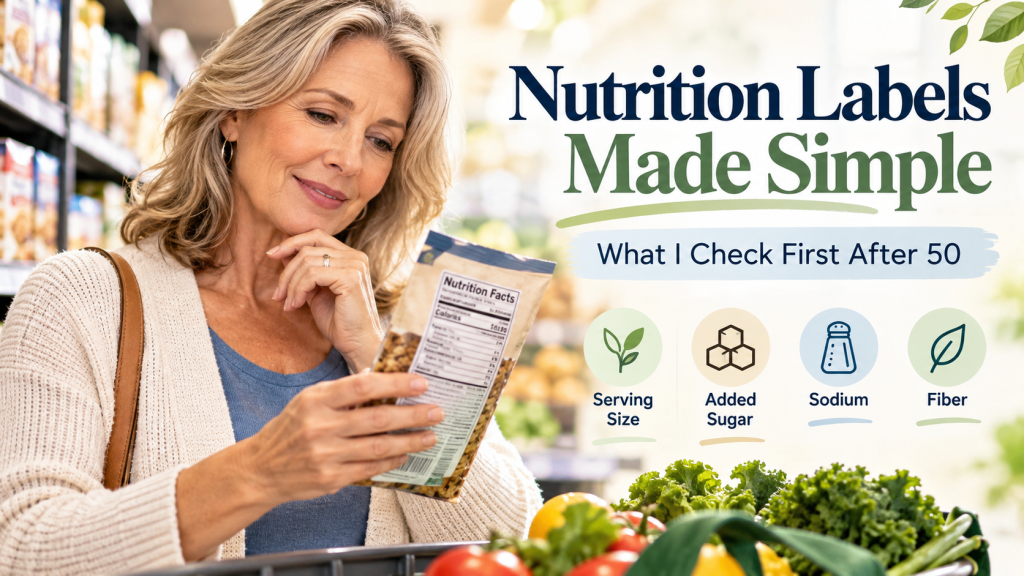
I used to pick up a package at the grocery store, glance at the calories, and think I had read the nutrition label.
Now I know I was missing most of the story.
As I’ve gotten older, I’ve become much more interested in what I’m actually eating. I don’t want grocery shopping to become complicated, and I certainly don’t want to stand in the aisle studying every number on every package.
But I’ve learned that a few parts of the Nutrition Facts label can tell me a lot very quickly.
Here are the things I now pay attention to first.
1. I Look at the Serving Size Before Anything Else
This was probably the biggest lesson for me.
The calories, sodium, sugar, fiber, and other numbers on the label usually apply to one serving—not necessarily the entire package.
That means a small bag or container that looks like one portion may actually contain two or more servings.
If I eat twice the serving size, I’m also getting roughly twice the calories and nutrients listed.
Another thing I learned is that the serving size is not necessarily a recommendation of how much we should eat. It reflects the amount people typically consume.
So now, before I look at calories, I check:
How many servings are in this package?
And how much am I actually going to eat?
That one question makes the rest of the label much easier to understand.
2. I Don’t Look at Calories Alone Anymore
For years, calories were the first thing I noticed.
Low calories meant “good.”
High calories meant “bad.”
I’ve learned that it isn’t quite that simple.
Calories tell us how much energy a food provides, but they don’t tell us everything about the quality of that food.
Two products can have similar calories but very different amounts of fiber, protein, sodium, added sugar, vitamins, and minerals.
So I still notice calories, but I no longer use that number alone to decide whether something belongs in my cart.
3. Added Sugars Matter More to Me Than I Realized
This is one part of the label I barely noticed in the past.
There is a difference between Total Sugars and Added Sugars.
Total Sugars may include naturally occurring sugars, such as those found in milk or fruit.
Added Sugars are sugars added during processing or preparation.
That distinction has become especially useful when I compare products such as yogurt, cereal, granola bars, sauces, and drinks.
Sometimes two products look almost identical from the front of the package, but the amount of added sugar is very different.
Now I turn the package around before believing the marketing on the front.
4. The % Daily Value Is More Useful Than I Thought
I used to ignore the % Daily Value column completely.
It looked too complicated.
But there is a simple guideline that makes it much easier:
Around 5% Daily Value or less is considered low.
Around 20% Daily Value or more is considered high.
That gives me a quick way to compare foods.
For nutrients I may want more of, such as dietary fiber, I may look for a higher percentage.
For nutrients I may want to limit, such as saturated fat, sodium, or added sugars, I usually prefer a lower percentage.
I don’t try to make every number perfect.
I just use the percentages as a quick comparison tool.
5. Sodium Can Add Up Surprisingly Fast
This is another number I started paying more attention to.
Foods don’t always taste extremely salty even when they contain quite a bit of sodium.
Bread, soups, sauces, frozen meals, deli foods, snacks, and other packaged foods can all contribute sodium throughout the day.
One serving may not look like much.
But if the package contains multiple servings—or if I eat several packaged foods during the day—the total can add up quickly.
That’s another reason serving size matters so much.
6. Fiber Is One of the First Things I Look For Now
As I’ve gotten older, I’ve become more interested in foods that help me feel satisfied and support a balanced diet.
So when I compare breads, cereals, crackers, or similar foods, I often look at the dietary fiber line.
I’m not trying to choose the product with the biggest number every single time.
I simply use it as one more clue when comparing similar foods.
Sometimes a product that looks “healthy” on the front of the package doesn’t contain as much fiber as I expected.
That has taught me something important:
The front of the package is advertising.
The Nutrition Facts label is information.
7. I Compare Similar Products Side by Side
This may be the easiest habit of all.
If I’m choosing between two yogurts, two breads, or two cereals, I turn both packages around and compare them.
I look at:
Serving size
Added sugars
Sodium
Fiber
Saturated fat
And then I choose the one that makes the most sense for what I need.
I’ve found this much easier than trying to memorize what every “healthy” food should contain.
What I No Longer Do
I no longer assume that words like “natural,” “light,” or “no added sugar” automatically tell me everything I need to know about a food.
I also don’t believe one number makes a food good or bad.
Food is more complicated than that.
Instead, I try to look at the whole picture.
How much will I actually eat?
How often do I eat this food?
What else am I eating during the day?
And does this product help me build the kind of diet I want?
Reading Labels Doesn’t Have to Be Complicated
I still don’t stand in the grocery store studying every ingredient and every percentage.
That would make shopping exhausting.
Instead, I’ve learned to look at just a few things:
Serving size first.
Then added sugar, sodium, fiber, and a few other nutrients depending on the food.
It takes only a few seconds.
And over time, those few seconds have made me feel much more confident about the foods I bring home.
Getting older has made me realize that healthy eating doesn’t have to mean eating perfectly.
Sometimes it simply means paying a little more attention.
Sunny’s One Line
I don’t need to understand every number on a nutrition label. I just need to know which numbers matter most to me.


Leave a Reply