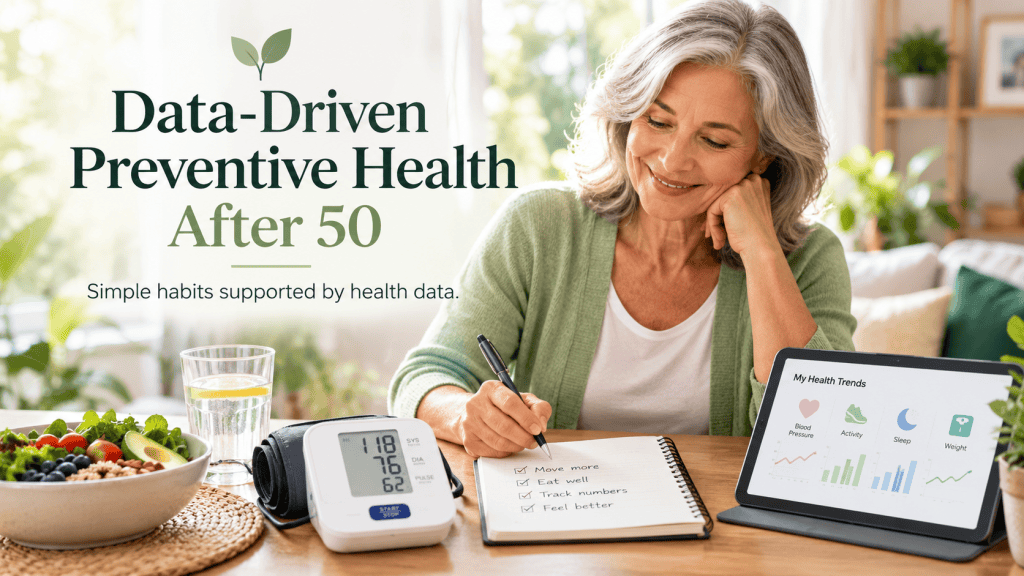
After 50, I think many of us start paying closer attention to our health.
Not because we want to worry more, but because we realize that small changes can matter.
A little more fatigue.
A little less movement.
A blood pressure number that seems higher than before.
A lab result that slowly changes from year to year.
None of these numbers tells the whole story by itself.
But together, they can help us notice patterns earlier.
That is what I like about data-based preventive health.
It is not about becoming obsessed with numbers. It is about understanding our own trends and using that information to have better conversations with our healthcare providers.
Here are seven health numbers worth paying attention to after 50.
1. Blood Pressure
Blood pressure is one of the simplest health measurements, but it can tell us a lot.
High blood pressure often does not cause obvious symptoms, which is why regular screening matters.
The U.S. Preventive Services Task Force suggests yearly blood pressure screening for adults age 40 and older, as well as for people at increased risk.
If you check your blood pressure at home, try to focus on the pattern rather than one isolated reading.
A single high number may be affected by stress, caffeine, poor sleep, or even rushing to an appointment.
What matters more is whether your readings are consistently changing over time.
2. Blood Sugar
Blood sugar is another important number to understand as we get older.
A fasting glucose test or A1C test can help show how your body is managing blood sugar.
Rather than waiting until a problem becomes obvious, it can be helpful to know your baseline and watch for changes over time.
If your numbers begin moving upward, that is a good reason to talk with your healthcare provider about diet, activity, weight, medications, and other factors that may be involved.
3. Cholesterol
Cholesterol is not just one number.
Your lab report may include total cholesterol, LDL, HDL, and triglycerides.
These values help your healthcare provider look at your overall cardiovascular risk along with other factors such as age, blood pressure, smoking history, diabetes, and family history.
Instead of focusing on whether one number is “good” or “bad,” look at how the numbers change from one test to the next.
That trend can be more useful than a single snapshot.
4. Weight and Waist Changes
Weight alone does not define health.
But unexpected or gradual changes in weight can sometimes tell us that something in our lifestyle or health has shifted.
Waist measurement can also provide useful information because abdominal fat is associated with metabolic and cardiovascular risk.
You do not need to weigh yourself every day.
For many people, checking occasionally and noticing long-term changes is enough.
The goal is awareness, not perfection.
5. Weekly Physical Activity
This is one of my favorite health numbers because it is something we can actually influence.
CDC guidance recommends that adults aim for at least 150 minutes of moderate-intensity physical activity each week, along with muscle-strengthening activity on at least 2 days.
That may sound like a lot, but it can be divided into smaller amounts throughout the week.
Walking, cycling, gardening, swimming, and many other activities can count.
Instead of asking, “Did I exercise enough today?” try asking, “How much movement did I get this week?”
That small change in thinking can make activity feel more realistic.
6. Sleep
Sleep is harder to measure perfectly, but it is still worth tracking.
You can simply pay attention to:
- how many hours you sleep
- how often you wake during the night
- how rested you feel in the morning
- whether your sleep pattern has changed
A smartwatch or phone can provide estimates, but you do not need a device to notice your own patterns.
If your sleep suddenly becomes much worse or stays poor for a long time, that information is useful to share with your healthcare provider.
7. Bone Health
Bone health becomes especially important as we age.
The U.S. Preventive Services Task Force recommends osteoporosis screening for women age 65 and older. It also recommends screening for postmenopausal women younger than 65 who have certain risk factors and are found to be at increased fracture risk.
Among U.S. adults age 50 and older, osteoporosis affects a meaningful portion of the population, which is one reason bone health should not be ignored.
Even before screening age, it can be useful to talk with your doctor about family history, menopause, low body weight, smoking, alcohol use, medications, and other factors that may affect bone strength.
The Most Important Number Is the Trend
One thing I have learned is that health numbers are most useful when we look at them over time.
A blood pressure reading from today.
A cholesterol test from last year.
A change in sleep over several months.
Each piece of information becomes more meaningful when we compare it with our own past.
That is why keeping simple records can be helpful.
You do not need a complicated health spreadsheet.
A notebook, phone note, or patient portal can be enough.
Write down important lab results, blood pressure readings, medications, screenings, and questions you want to ask at your next appointment.
Prevention Does Not Mean Prediction
Health data cannot tell us exactly what will happen in the future.
And one abnormal number does not automatically mean something is seriously wrong.
The purpose of tracking is not to diagnose ourselves.
It is to notice changes earlier and give ourselves and our healthcare providers better information.
According to the CDC, chronic diseases remain a major cause of illness and disability in the United States, and many share modifiable risk factors such as physical inactivity, poor nutrition, smoking, and excessive alcohol use.
That is why prevention is often built from small, ordinary choices repeated over time.
Start With One Number
You do not have to track everything at once.
This week, choose just one.
Maybe check your blood pressure.
Look at your last cholesterol test.
Add up how many minutes you walked this week.
Or schedule a screening you have been putting off.
The goal is not to become afraid of your health data.
The goal is to understand your body a little better.
Sunny’s One Line:
Your health is more than a number, but the right numbers can help you notice the story your body is telling.
This article is for general educational purposes only and is not a substitute for individualized medical advice, diagnosis, or treatment.


Leave a comment